Hearts of Iron IV Division Templates: Builds That Work
Build Hearts of Iron IV division templates for defense, tank offensives, and naval invasions. Compare battalions, combat widths, and support companies.
Jump to
Which Division Templates Should You Use?
Start your Hearts of Iron IV division templates with nine infantry battalions for frontline defense, six infantry plus one artillery for a compact mixed formation, and tanks supported by motorized infantry for breakthroughs. These Bolivar 1.14+ single-player builds cover different jobs; add marines for landings and mountaineers for rough terrain.
Bolivar 1.14+ Single-Player Templates
The battalions below belong in the main formation. Support companies are separate additions.
| Template | Combat battalions | Combat width | Role |
|---|---|---|---|
| Compact infantry | 6 infantry, 1 artillery | 15 | General-purpose infantry |
| Defensive infantry | 9 infantry | 18 | Holding the main frontline |
| Offensive infantry | 9 infantry, 2 artillery | 24 | Infantry attacks |
| Port guard | 5 infantry | 10 | Defending ports and supply hubs |
| Motorized infantry | 9 motorized infantry, 2 motorized rocket artillery | 24 | Accompanying armored advances |
| Light armor | 7 light tanks, 5 motorized infantry | 24 | Early armored attacks |
| Medium armor | 8 medium tanks, 8 motorized infantry, 1 medium self-propelled artillery | 35 | Breaking through enemy lines |
| Marines | 9 marines | 18 | Amphibious operations |
| Mountaineers | 12 mountaineers, 1 line anti-air | 25 | Mountain and rough-terrain combat |
| Paratroopers | 9 paratroopers | 18 | Airborne operations |
To the Bitter End launched on November 19, 2026. The compositions and widths above belong to Bolivar 1.14+; use that version context when choosing a build, and inspect the final stats in your division designer.
Official page: Hearts of Iron IV (paradoxinteractive.com)
Infantry Builds for Holding and Attacking
 Image: Steam / Paradox Development Studio
Nine Infantry: An 18-Width Defensive Line
The 9-0 formation contains nine infantry battalions and no line artillery. Its job is to occupy the front and defend while your attacking divisions concentrate elsewhere.
Add engineers for entrenchment, support artillery for additional firepower, and support anti-air when enemy aircraft threaten the front. Each addition creates another equipment requirement, so prioritize companies your factories can keep supplied.
Avoid turning every defensive division into an artillery-heavy attacker. Line artillery adds soft attack, but organization depends on the battalion mix. Adding more battalions can increase attack and defense while lowering the division’s organization.
Six Infantry and One Artillery: A 15-Width Mixed Formation
The 6-1 build combines six infantry battalions with one artillery battalion. Engineers, support anti-air, and support artillery round out the suggested support package.
Use this smaller formation when you want infantry with line artillery without committing to the larger 24-width build. Check your artillery stockpile before converting existing divisions: the change immediately creates equipment demand across every division using that template.
Nine Infantry and Two Artillery: A 24-Width Attacker
The 9-2 build adds two line artillery battalions to nine infantry battalions. Its emphasis is offensive infantry combat, with more artillery committed to each division.
Concentrate these divisions where you intend to attack. Keep ordinary infantry on the rest of the line so your artillery production supports the offensive formations you actually need.
Soft attack matters against infantry-heavy enemies. Against armored formations, inspect hard attack and piercing instead of assuming additional artillery solves the matchup.
Tank and Motorized Builds for Breakthroughs
 Image: Steam / Paradox Development Studio
Light Armor: Seven Tanks and Five Motorized
The 24-width light armored formation combines seven light tank battalions with five motorized infantry battalions. Engineers provide its suggested starting support company.
Use existing light tank equipment for early armored operations, then plan a transition toward medium tanks around 1941. Keep motorized infantry in the formation to support organization rather than filling every slot with tanks.
Watch fuel and supply before launching the attack. Armored formations demand more of both than ordinary infantry.
Medium Armor: Eight Tanks, Eight Motorized, One SP Artillery
The 35-width medium armored build contains:
- Eight medium tank battalions.
- Eight motorized infantry battalions.
- One medium self-propelled artillery battalion.
- An engineer support company.
Self-propelled artillery introduces another vehicle production requirement. If you replace it with motorized infantry or motorized artillery, inspect the resulting width and stats before saving; those substitutions change the formation.
For the mechanized version, replace the eight motorized infantry battalions with eight mechanized battalions. Its suggested support package adds maintenance and logistics alongside engineers.
Make that conversion when your equipment stockpile can cover it. Replacing trucks with mechanized equipment across an entire armored force creates immediate replacement orders.
Match the Vehicles to the Opponent
Against infantry-heavy single-player armies, prioritize soft attack in your tank designs. Against armored opponents, give hard attack and piercing more attention.
Keep production cost in view. Expensive tanks compete with the need to equip more divisions and replace losses. The same template can perform differently with different tank designs, doctrines, and Military Industrial Organization bonuses.
For late-game armor, the corresponding 35-width formation uses eight modern tank battalions, eight mechanized battalions, and one modern self-propelled artillery battalion, supported by engineers, maintenance, and logistics.
Motorized Infantry: Keep Up With the Tanks
The 24-width mobile infantry build uses nine motorized infantry battalions and two motorized rocket artillery battalions. Regular motorized artillery is an alternative when you are not producing motorized rocket artillery.
Use these divisions to accompany armored advances. Their speed lets them move with the offensive force while your foot infantry covers the broader front.
Special Forces for Landings, Mountains, and Airborne Operations
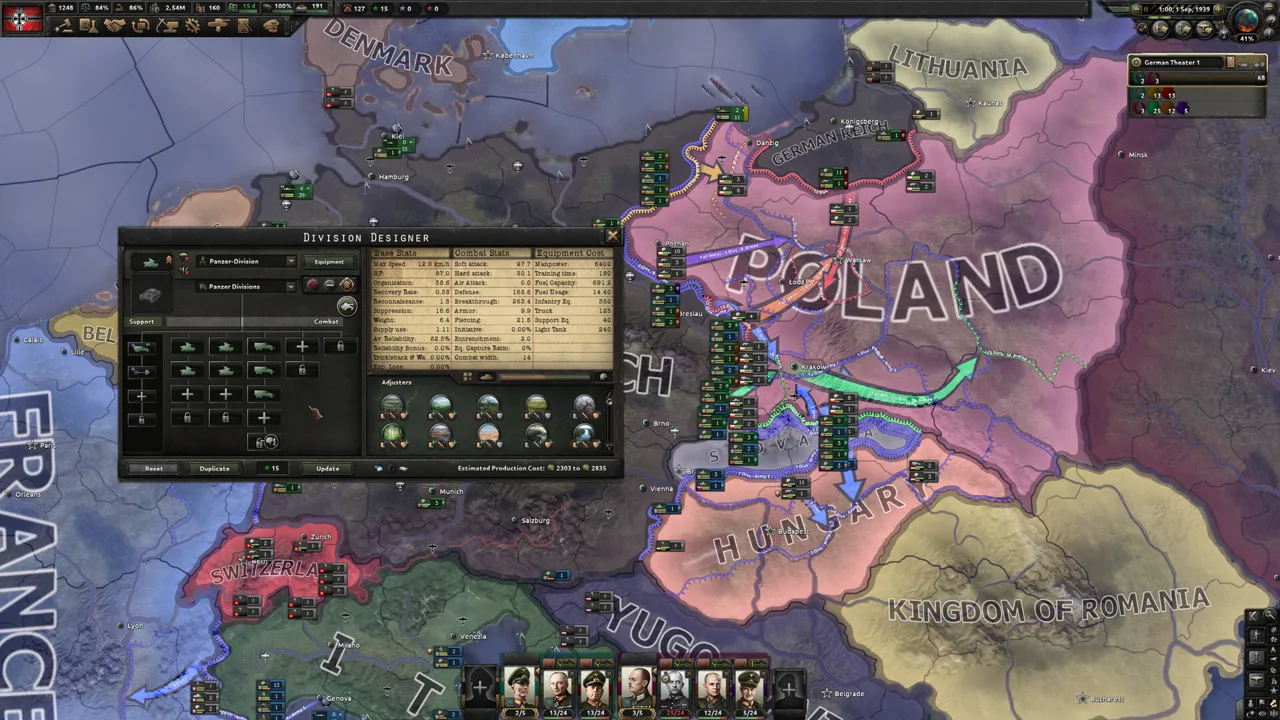 Image: Steam / Paradox Development Studio
Marines: Nine Battalions at 18 Width
Nine marine battalions provide a starting formation for amphibious invasions and wet terrain. The suggested support companies are engineers, support anti-air, and support artillery.
Add engineers for their river-crossing and amphibious benefits. Inspect the terrain modifiers at the bottom of the designer when comparing changes to a landing force.
For a later amphibious armored formation, the Bolivar build uses ten amphibious medium tank battalions and eight amphibious mechanized battalions at 36 width. Engineers, maintenance, and logistics complete its support package. Reserve that investment for an industry capable of supplying the specialized vehicles.
Mountaineers: Twelve Battalions Plus Line Anti-Air
The 25-width mountain formation contains twelve mountaineer battalions and one line anti-air battalion. Engineers, support anti-air, and support artillery are its suggested support companies.
The line anti-air battalion and support anti-air company occupy different parts of the designer. Include the line battalion when reproducing this exact composition.
Special forces doctrine can affect final width. Read the displayed value after applying your doctrine rather than relying solely on the build’s name.
Paratroopers: Nine Battalions at 18 Width
The nine-battalion airborne formation uses engineers, support anti-air, and support artillery.
Plan a route to supply when choosing the drop objective. Capturing a port can let the rest of your army arrive by sea; isolated airborne divisions need a way to connect with the main force.
Port Defense and Occupation Suppression Need Different Templates
A port guard is a deployed combat division. An occupation garrison is assigned through the occupied-territory interface. Build each for its own task.
For a low-cost port guard, use five infantry battalions at 10 width. Place guards on ports and important supply hubs. Reinforce especially valuable ports with stronger infantry and support companies when equipment permits.
For occupation suppression, start with a single cavalry battalion. Once you add military police, a larger formation of 20–25 cavalry battalions spreads the support-company requirement across more suppression capacity.
To assign the occupation template, open your country flag, enter Occupied Territories, and select the garrison template there. Adding military police to a deployed port guard does not replace that assignment.
Combat Width and Support Companies
Combat width determines how much of a force can participate in a battle. Terrain sets the available space.
Bolivar 1.14+ Terrain Widths
| Terrain | Base combat width | Additional width |
|---|---|---|
| Mountains and marshes | 50 | 25 |
| Forests and jungles | 60 | 30 |
| Plains, deserts, and hills | 70 | 35 |
| Urban terrain | 80 | 40 |
Match formations to the terrain you expect to fight across, but inspect organization, equipment, and supply alongside width. A formation that fits neatly still needs the resources to fight.
Support companies should address the division’s actual job:
| Support company | Relevant benefit |
|---|---|
| Engineers | Entrenchment and benefits for river crossings, forts, and amphibious attacks |
| Support artillery | Additional firepower |
| Support anti-air | Air attack and additional piercing |
| Logistics | Reduced supply consumption |
| Maintenance | Increased equipment reliability |
| Signals | Increased initiative, including planning and reinforcement benefits |
| Field hospital | Manpower trickleback and reduced experience loss from casualties |
| Military police | Occupation suppression |
Prioritize engineers on entrenched defenders and marines. Add logistics to supply-hungry armored formations operating in constrained theaters. Check the equipment requirement after each addition instead of filling support slots automatically.
Upgrade Templates Without Draining the Frontline
Changing a template affects every division assigned to it. Those divisions immediately request any additional manpower and equipment, while surplus equipment and manpower return to the national pool.
Duplicate the template before a major upgrade, then convert selected divisions as equipment becomes available. Duplication costs 0 Army XP. Adding or swapping a combat battalion generally costs 5 Army XP, while introducing a regiment of a new type costs 25 Army XP, including its first battalion.
Before converting a formation:
- Inspect the new manpower and equipment requirements.
- Compare them with your available stockpile.
- Check organization, combat width, speed, and supply use.
- Convert selected divisions when they can refill before their next battle.
Use equipment priority deliberately. Elite templates receive priority for better equipment ahead of regular and reserve templates. Apply that setting to your attacking formations or special forces when you want scarce modern equipment concentrated there.
If Army XP is the bottleneck, use military high command appointments that provide daily Army XP or exercise divisions. Exercise also consumes equipment through training losses, so watch the stockpile while building the experience needed for your next change.
Continue exploring
Hearts of Iron IV Ideologies: Politics and War Guide
Learn how Hearts of Iron IV ideologies affect diplomacy, war goals, and political change. Compare the four groups, IDs, and paths to a new government.
Hearts of Iron IV Man the Guns: Features & Free Access
Hearts of Iron IV Man the Guns is part of the base game. Explore ship design, naval mines, national focuses, and what its free integration means for you.
Join the community
Official channels for news, updates and player help: