Hearts of Iron IV Warfare Guide: Win Wars With Better Supply
This Hearts of Iron IV warfare guide covers division design, supply, air support, and naval invasions. Learn to break fronts and destroy encircled armies.
Jump to
How to Win Wars in Hearts of Iron IV
This Hearts of Iron IV warfare guide comes down to a repeatable cycle: hold a supplied frontline, concentrate your strongest divisions, break through, and encircle enemy troops. Keep equipment and organization healthy throughout the operation. Stop attacks that exhaust your army, restore its fighting strength, and resume where terrain and supply favor you.
Build your campaign around the relationship between your industry and your army. Adding battalions creates equipment demand; adding divisions increases supply consumption. An impressive division template becomes a liability when your factories cannot equip it or your transport network cannot support it.
2024 Base-Game Combat Priorities
| Element | Starting target or action | Battlefield purpose |
|---|---|---|
| Infantry organization | Aim for around 50 | Maintain staying power while holding the line |
| Other divisions’ organization | Aim for around 30–40 | Keep offensive formations fighting long enough to exploit an opening |
| Army command | Keep a standard army within its general’s displayed limit; the baseline is 24 divisions | Avoid command penalties |
| Ground supply | Connect supply hubs through railways or sea routes | Deliver supply to the fighting area |
| Offensive maneuver | Break through and close enemy retreat routes | Destroy trapped divisions when they lose combat |
Use those organization figures as starting targets for division design. Read the terrain, combat, and supply tooltips before committing an army to an operation.
Official page: Hearts of Iron IV (paradoxinteractive.com)
Prepare Industry for the War You Plan to Fight
Choose your likely enemy and theater before spreading research across equipment categories. Fighting across a land border creates different demands than supplying an overseas campaign.
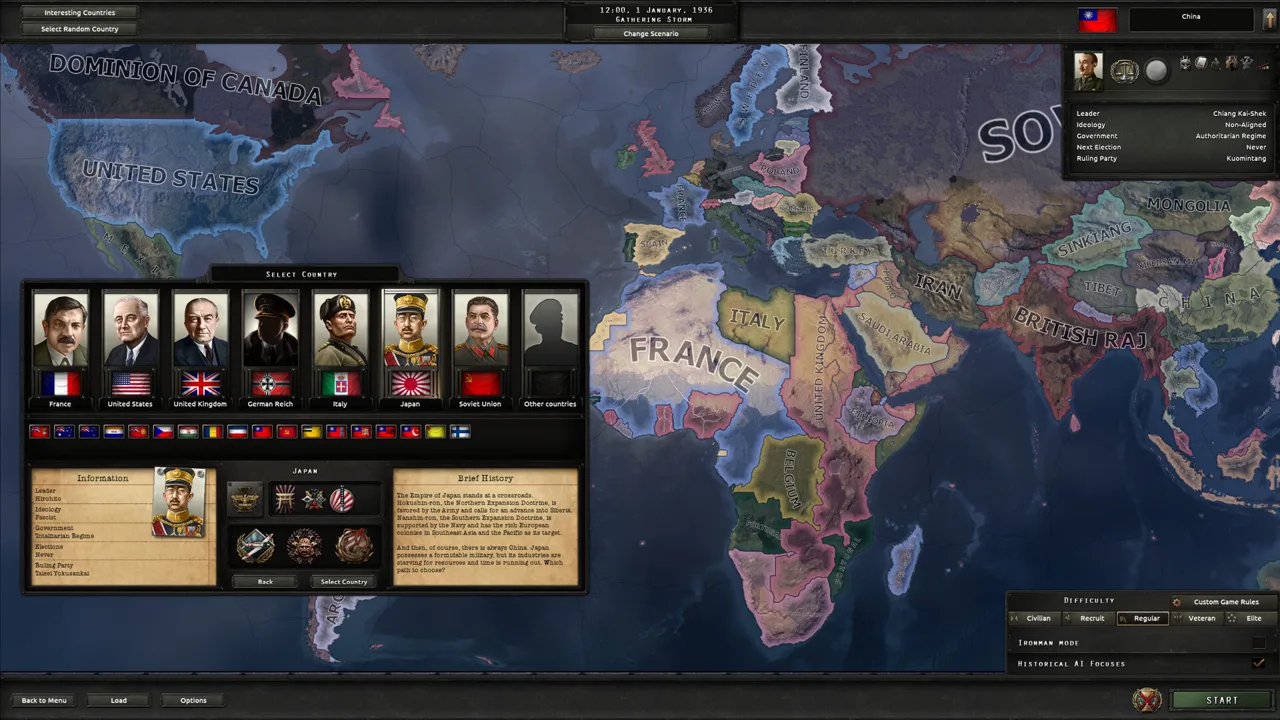 Image: Steam / Paradox Development Studio
For a country with limited factories, concentrate production on equipment you can field in useful quantities. Keep infantry weapons, support equipment, and artillery aligned with your templates. Add tanks, aircraft, and specialized formations when your industrial base can support their production and replacement losses.
Match Construction to Your War Deadline
Civilian factories support construction, repairs, and resource trade. Military factories produce equipment. Dockyards build ships and convoys.
Expand civilian industry when you have time for that construction capacity to contribute. Shift toward military production early enough to equip your army before the expected war. Avoid choosing a universal conversion date: your starting industry, national focuses, and immediate threats determine the schedule.
Look ahead through the national focus tree for factories, research slots, useful research bonuses, and ways to remove national penalties. Check prerequisites and mutually exclusive branches before committing.
Protect Production Efficiency
Military production lines become more productive as their efficiency grows. Frequent equipment changes disrupt that output.
Before switching models or expanding templates:
- Check your equipment stockpiles and current deficits.
- Check whether the new equipment requires additional imported resources.
- Keep replacement production running for divisions already fighting.
- Delay expensive template changes until you can meet their equipment demand.
Keep research focused on your campaign. Industrial and electronics technologies support your broader war effort, while infantry equipment, artillery, aircraft, and armor research should follow what you actually intend to deploy. Avoid stacking early research penalties across technologies you cannot produce yet.
Design Divisions Around a Specific Job
Separate the work of holding territory from the work of breaking through it.
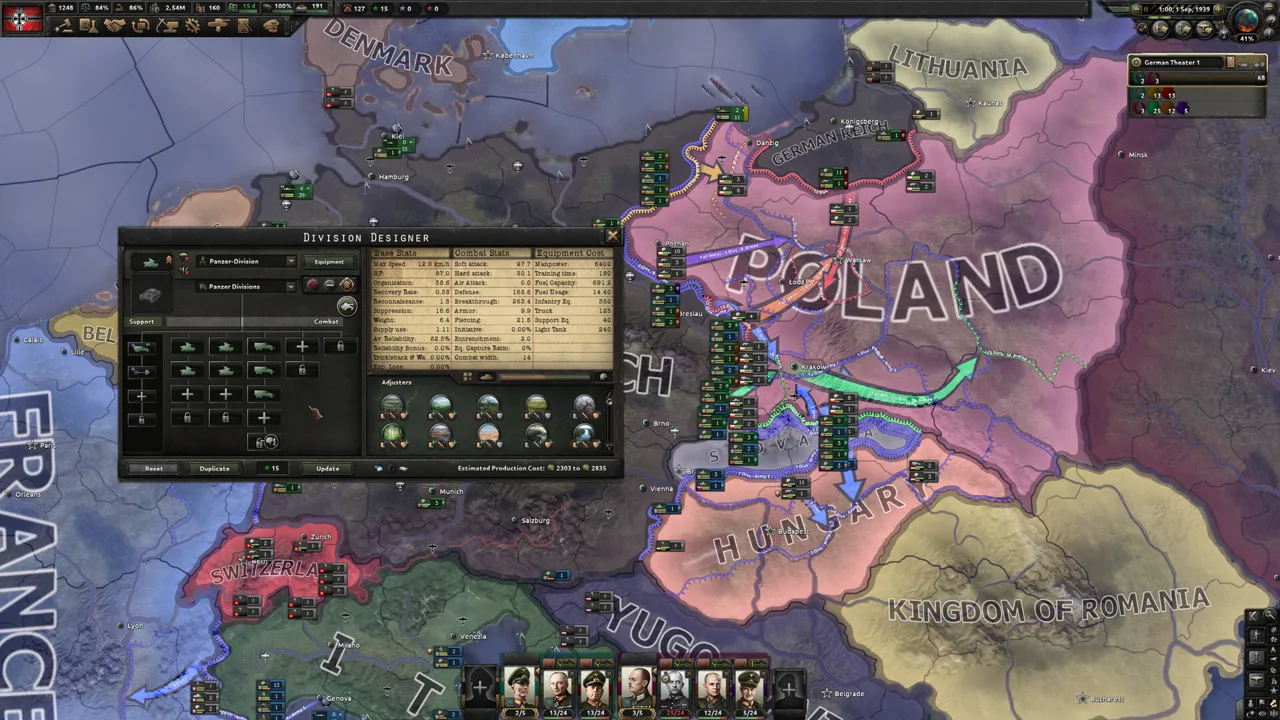 Image: Steam / Paradox Development Studio
Use infantry to maintain the frontline and protect the flanks of your offensive. Concentrate armored or otherwise stronger attacking formations where their advantages can matter. For mountains, amphibious assaults, and other specialized operations, consider the corresponding special forces.
Read the Stats That Explain Combat
Organization determines how long a division can remain in combat before retreating. HP relates to its ability to absorb losses in manpower and equipment. Watch both organization and strength: a formation can recover its willingness to fight while still needing replacement weapons.
Soft attack matters against softer targets such as infantry. Hard attack matters against the armored portion of enemy formations. Match your investment to the opponent instead of adding expensive weapons without a clear target.
Combat width determines how much space a division occupies in battle. Terrain limits the available width, and attacks from additional directions can expand it. Inspect the terrain where you expect to fight before settling on a template.
Supply use is an operating cost. Compare any increase in combat power with the additional demand it places on your supply network.
Expand Templates Without Creating an Army-Wide Shortage
Editing a template also changes the requirements of deployed divisions using it. Adding artillery or armor across an entire army can create an immediate equipment deficit.
Duplicate the template when you want to introduce a new formation gradually. Equip the new design before spreading it through your existing army.
Add support companies for a purpose. Pair engineers with marines for amphibious assaults. Check the equipment cost alongside the stat changes.
Fix Supply Before Reinforcing a Stalled Front
Open supply map mode with F4 when an offensive slows down. Inspect the connection between your capital, rail network, supply hubs, ports, and frontline units.
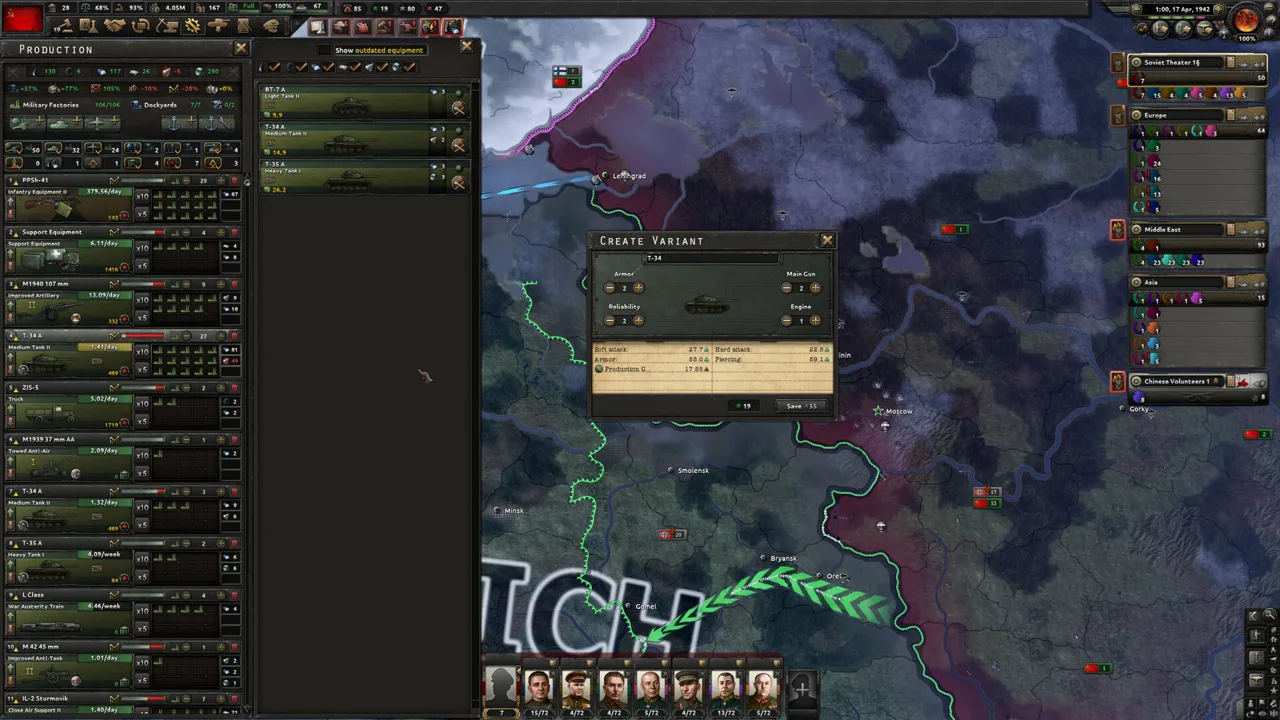 Image: Steam / Paradox Development Studio
A stockpile of infantry equipment does not solve a transport bottleneck. Railways move supply between connected points; they do not distribute it to nearby divisions by themselves. Supply hubs and ports provide that distribution.
Work through the problem in order:
- Check the route. Confirm that the relevant hub or port connects to your supply network.
- Inspect capacity. Look for railway or port limitations along that route.
- Check transport equipment. Maintain enough trains, trucks, and convoys for the network.
- Adjust motorization. Use trucks to extend hub supply distribution where needed.
- Reduce local demand. Move unnecessary divisions away from an overloaded area.
- Repair or expand the network. Improve the connection your next offensive will depend on.
Avoid feeding additional divisions into a region that already cannot supply its army. Concentrate enough force to achieve the objective, then leave room for the transport network to sustain it.
Budget Fuel for Active Operations
Tanks, motorized formations, aircraft, and ships draw on fuel. Running out imposes severe penalties on equipment that needs it.
Check consumption before launching simultaneous air, naval, and armored operations. Import oil when necessary, research fuel-related improvements, and stop unnecessary exercises when reserves tighten. Use naval strike force missions to keep the main fleet in port until an engagement calls it out.
Turn a Defensive Line Into an Encirclement
Assign generals and organize your front before the war begins. Match commanders and formations to the terrain and the operation.
A frontline order positions divisions along the border. An offensive line gives them an advance objective. Start with a limited objective you can support instead of ordering the entire army toward a distant capital.
Exploit Enemy Exhaustion
Enemy attacks consume organization. When a failed assault leaves opposing divisions weakened, concentrate a counterattack against a suitable section of the line.
Inspect the battle window before continuing a costly attack. Terrain, weather, river crossings, organization, equipment strength, and supply can explain why a seemingly stronger army is struggling.
Follow a breakthrough with a controlled sequence:
- Attack a narrow section where terrain suits your offensive formations.
- Move mobile units through the opening.
- Advance around the enemy’s position to close its retreat routes.
- Bring infantry forward to hold the corridor and protect its flanks.
- Defeat the trapped divisions.
- Restore organization and supply before the next push.
An encircled division is destroyed when it loses combat without a valid retreat route. That makes closing the pocket more valuable than pushing the same enemy backward repeatedly.
Keep the corridor supplied and defended. Avoid sending mobile divisions so far ahead that the enemy can cut them off instead.
Coordinate Fighters and Close Air Support
Aircraft need the correct mission, operating region, range, and airbase capacity to contribute.
Use fighters on air superiority to contest enemy aircraft over the fighting area. Use interception when your priority is engaging enemy bombers and support aircraft. Assign close air support to assist land battles.
Before increasing aircraft numbers, check:
- Whether the wings have active missions.
- Whether they are assigned to the intended air region.
- Whether their range provides useful coverage.
- Whether their airfields are overcrowded.
- Whether fuel is available.
Move wings forward as the frontline advances, while keeping them within airfield capacity. Radar can assist aircraft detection around important operating areas.
Choose additional aircraft around a clear task. Tactical bombers offer multiple mission options; strategic bombers attack industry and infrastructure; naval bombers target ships and ports. Fund the missions your campaign needs before expanding into every aircraft category.
Use Naval Power to Secure Movement and Supply
Give each naval force a defined assignment. Keep submarines separate from surface forces so you can manage their missions deliberately.
Use submarines for convoy raiding. Assign suitable escorts to protect vulnerable convoy routes. Use patrols to find enemy ships and strike forces to respond with concentrated combat power.
Convoys support trade, overseas troop transport, and amphibious operations. Keep convoy production and naval repairs in your industrial plan.
Prepare the Landing and Its Supply Route Together
Before launching a naval invasion:
- Assign the invasion force, departure point, and landing destination.
- Check invasion preparation and capacity.
- Provide the required convoys.
- Establish the required naval superiority along the route.
- Plan how the landing force will capture a port and receive supply.
Use marines for difficult amphibious assaults. Once ashore, secure supply before sending additional divisions into the beachhead.
Defend your own ports with assigned troops. An area-defense order can prioritize ports, but those divisions still need equipment and enough strength to resist a landing. Distinguish these troops on the map from the garrison template used through occupation management.
Sustain the Army After the Breakthrough
Use the logistics screen to track whether your army is consuming equipment faster than factories replace it. A growing deficit calls for a production adjustment, reduced losses, or a pause in expansion.
Manage reinforcement and upgrade priorities around the immediate military problem. Reinforcements replace missing equipment; upgrades replace older equipment with newer models. New divisions compete for those same weapons.
Prioritize existing formations when an offensive depends on restoring their strength. Keep recruitment aligned with the equipment you can spare, especially when another front needs defending.
Watch occupation requirements as territory expands. Assign an appropriate suppression template and provide its required manpower and equipment through occupation management. Resistance can damage infrastructure and factories, pulling construction capacity into repairs.
Finally, distinguish taking territory from ending the war. Victory points contribute to capitulation, but one enemy’s surrender does not necessarily settle a wider conflict. Check the war screen, identify the remaining opponents, and choose your next objective around the forces and supply routes you can sustain.
Continue exploring
Hearts of Iron IV No Step Back: DLC Features Guide
Explore Hearts of Iron IV No Step Back, including Soviet focus trees, the tank designer, army spirits, and railway guns. Find out what the expansion adds.
Hearts of Iron IV Tutorial: Learn Your First Campaign
Start this Hearts of Iron IV tutorial to learn research, factories, division templates, supply, and combat, then put your first campaign on solid footing.
Join the community
Official channels for news, updates and player help: